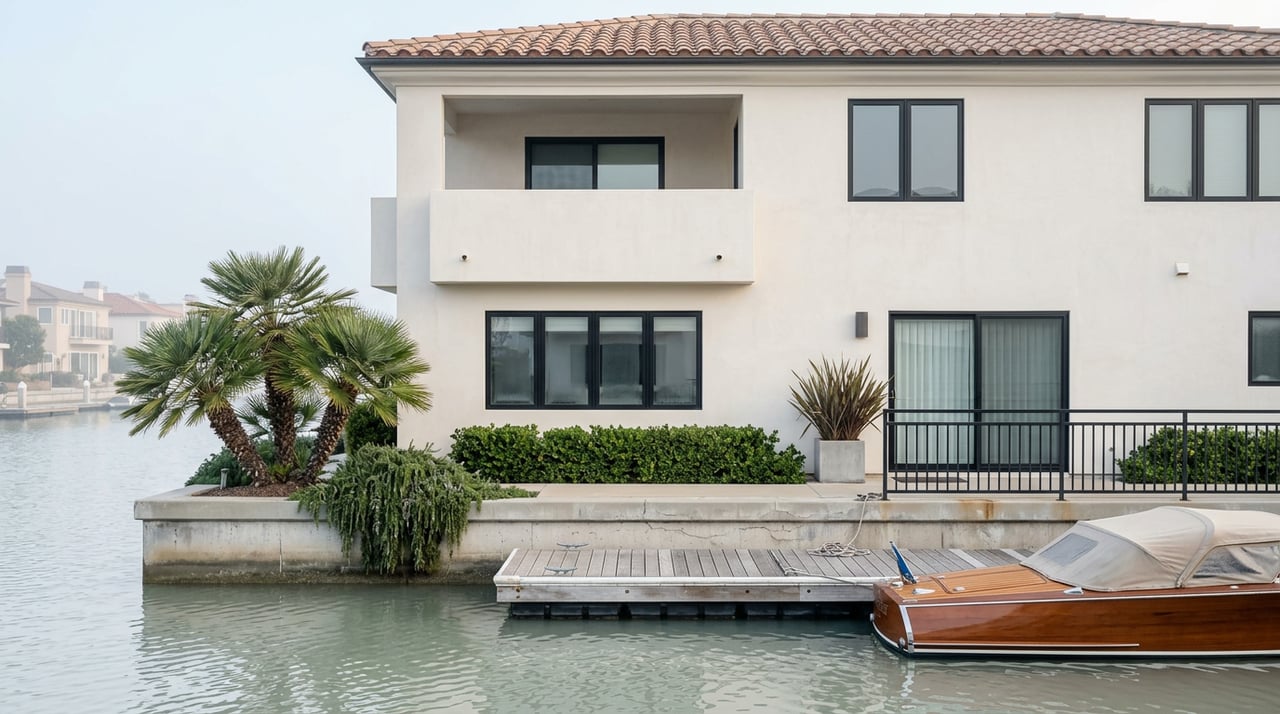
A Beacon Bay home listed at $3,495,000 went into escrow in late June 2026. On paper, the price looked like a steal for waterfront in lower Newport Bay, the kind of number that makes a buyer coming from Harbor Island or Linda Isle wonder what they're missing. What they're missing shows up a few pages into the disclosure package, in a phrase most buyers have never had to price out before: Tidelands Leasehold.
That phrase is not boilerplate. It means the buyer is not purchasing the ground under the house. They're purchasing the house, and separately signing a new 50-year lease with the City of Newport Beach for the dirt it sits on. The rent on that lease is set at roughly 2.5% of the purchase price, adjusted annually for inflation, and it stacks on top of ordinary property tax rather than replacing it. On a $3,495,000 home, that's approximately $87,375 a year in ground rent alone, plus roughly $45,435 in property tax at a typical 1.3% rate. Call it $132,810 a year, or just under 4% of the purchase price, before a single mortgage payment is made.
That number is the actual price of a Beacon Bay home. The listing price is only the entry fee.
Why the City Never Sold This Land
Beacon Bay sits on 2.8 acres divided into 72 residential lots, and the City of Newport Beach doesn't own that land outright either. It holds the land in trust for the State of California under a series of legislative grants collectively known as the Beacon Bay Bill, most recently updated as Chapter 74 of the Statutes of 1978. Thirty-eight of the 72 lots were built on partially or entirely filled tide and submerged land, meaning the ground itself used to be part of the harbor. California's public trust doctrine treats tidelands as held for the benefit of the public, which is why the city can lease building lots to homeowners but can't simply deed the land away the way it would in a standard subdivision.
That legal structure is why Beacon Bay operates differently from almost every other waterfront pocket in the harbor. It's not a homeowners association quirk or a developer's financing gimmick. It's the same statutory framework that governs commercial marina leases, yacht club moorings, and fuel docks throughout Newport Harbor, applied here to single-family lots instead of slips.
The Part of the Lease That Doesn't Behave Like a Lease
Most ground leases lose their bite over time. A homeowner who locks in rent on a 99-year lease in 1975 is often thrilled decades later, because the rent stayed fixed to a 1975 land value while the house appreciated freely. That's the classic ground-lease arbitrage, and it's the reason some buyers seek these deals out.
Beacon Bay doesn't work that way. When a home resells, the seller's old lease doesn't transfer with a legacy rent basis. The buyer signs a brand new 50-year lease, and the rent resets to 2.5% of whatever they just paid. If the home sells for more than the last transaction, the ground rent goes up with it, immediately, not gradually through CPI creep. The lease is permanently re-anchored to current market value at every transfer.
That single mechanism explains why Beacon Bay's price-per-square-foot has never turned into a legacy bargain the way some old ground leases elsewhere have. The city isn't renting out 1981 land values with modest inflation adjustments. It's renting out today's land value, every time a deed changes hands.
Compare that to Lido Peninsula, a few minutes away, where homes also sit on leased land but the lease is a flat monthly fee, commonly cited in recent listings somewhere between $2,695 and $3,237 a month, independent of what the individual home sells for. Two homes on the same street can carry the identical lease payment regardless of price. Nearby Bayshores, by contrast, markets its roughly 250 single-family homes with no land-lease line item at all. Two of the three enclaves stack a recurring ground payment on top of ordinary property tax, and they calculate that payment in opposite ways.
| Enclave | Land arrangement | Ground rent mechanism | What happens at resale |
|---|---|---|---|
| Beacon Bay | Leasehold, City of Newport Beach tidelands | 2.5% of purchase price annually, plus CPI adjustments | New 50-year lease, rent recalculated to the new sale price |
| Lido Peninsula | Leasehold, resort-administered | Flat monthly fee, unrelated to sale price | Fee continues under the existing lease term |
| Bayshores | No land-lease structure in listings | Standard property tax only | Nothing to recalculate at sale |
A buyer comparing a Beacon Bay listing to a Bayshores listing on price per square foot alone is comparing two different cost structures wearing the same waterfront view.
What a Lender Actually Checks
Leasehold land doesn't mean unfinanceable land. The lease itself allows the homeowner to encumber it with a deed of trust or mortgage in a bona fide lending transaction, without needing the city's consent first. Buyers who assume a ground lease rules out conventional financing are working from an outdated assumption.
What does change is the underwriting conversation. Lenders on leasehold property typically want the remaining lease term to outlast the loan term by a comfortable margin, and government-backed loan programs carry their own specific leasehold rules that can be stricter than a conventional lender's. A 30-year mortgage on a lease with 22 years left is a very different underwriting exercise than the same mortgage on a lease with 48 years left. This is exactly the kind of detail that surfaces late in escrow if it isn't asked about early, and it's worth raising with a lender before writing an offer, not after.
The Date That Isn't the Same for Every Lot
Here is where a Beacon Bay purchase gets genuinely lot-specific rather than community-wide. State Lands Commission records show that leases issued under the form the city adopted in 1994 were set to run through 2044. That's a fixed horizon tied to that particular round of lease renewals, not a rolling 50 years from whenever a given lease was signed.
At the same time, current listing practice describes a fresh 50-year lease being issued to the buyer at the time of each individual sale. Both things are true, which means the leasehold clock is not uniform across the enclave. A home that changed hands recently likely carries a lease running closer to a full 50 years from that transaction. A home that hasn't turned over since the 1990s may still be operating under the older 2044 horizon. The renewal isn't automatic either. Extending a lease requires a written request to the city, and the decision sits entirely within the city's discretion, along with an option fee tied to how many additional years are being purchased.
The practical takeaway for a buyer isn't a blanket deadline to worry about. It's a specific document to ask for on any given lot: the actual lease, with its actual commencement and termination dates, rather than an assumption borrowed from a neighbor's listing sheet.
Local Experience With This Exact Structure
This isn't theoretical for our team. Steve High has personally listed property inside Beacon Bay's leasehold structure, including 18 Beacon Bay through Villa Real Estate, a transaction that carried the same 2.5%-of-purchase-price lease terms described above. The community continues to see steady activity under this structure. Beyond the $3,495,000 home that went into escrow in late June, a Beacon Bay property listed for lease in March 2026 was asking $75,000 a month, evidence that the leasehold arrangement hasn't dampened demand for the location, only changed how that demand gets priced.
Frequently Asked Questions
Can a buyer ever purchase the land under a Beacon Bay home outright? No. The land is held by the City of Newport Beach in trust for the State of California under the Beacon Bay Bill. Homeowners lease the lot; they do not and cannot acquire fee-simple title to it.
Does the ground lease transfer with the house at resale, or does it reset? Current practice has the buyer sign a new 50-year lease at the time of purchase, with the annual rent recalculated at 2.5% of the new sale price rather than carried over from the seller's prior rent basis.
Is 2044 a deadline for every Beacon Bay lease? Not necessarily. That date applies specifically to leases issued under the city's 1994 lease form. Homes that have changed hands more recently typically carry a newer 50-year term set from their own transaction date. Buyers should confirm the specific commencement and termination dates on the lot they're considering rather than assume a single community-wide expiration.
Beacon Bay rewards a buyer who does the lease math before the offer, not after. If you're comparing a leasehold listing here against a fee-simple option elsewhere in the harbor and want the real annual carrying cost worked out before you write a number, High | Corkett can walk through the specific lot's lease terms with you. Work With Us — Start a Confidential Consultation.