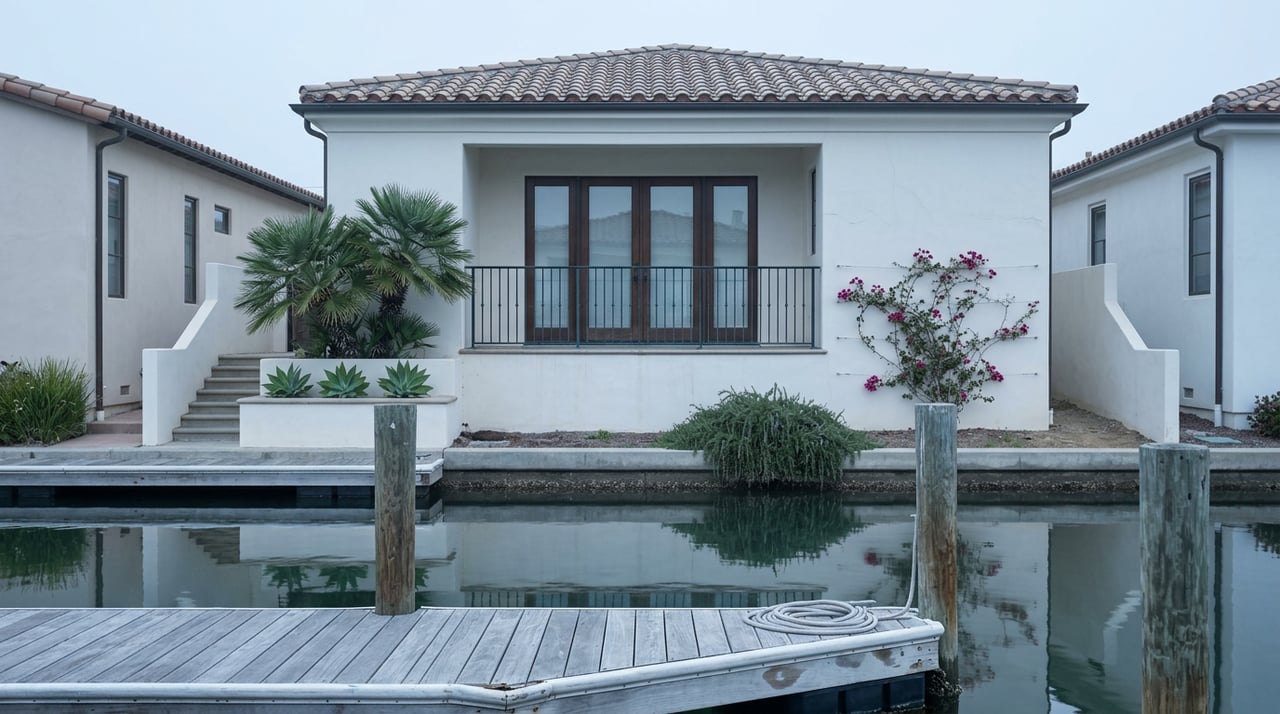
Pull up two active Harbor Island listings side by side and the math stops working. One property, a combined pair of lots at the water's edge, is priced at $59,000,000 for roughly 3,677 square feet of living space. Another, a few doors down on Harbor Island Drive, is priced at $9,895,000 for 4,440 square feet, more house, for a sixth of the price. On paper this looks like a pricing error. On the water, it isn't one. It's the clearest illustration of how value actually gets assigned on this island, and it has almost nothing to do with the floor plan.
Harbor Island is a small, gated enclave off Beacon Bay, tucked between Linda Isle and Balboa Island, made up of about thirty single-family homes strung along a single street and reached across one guarded bridge, according to Wikipedia's entry on the community. Every lot backs onto deep water. Every home has a private dock. And because there are so few of these lots, and they trade so rarely, the usual shorthand buyers bring from other markets, price per square foot, breaks down almost immediately.
The Numbers That Don't Reconcile
Here is what those two listings actually look like when the frontage and dock data are laid next to the price tag.
| Property | Water Frontage | Dock Capacity | Interior Size | List Price | Implied $/sq ft |
|---|---|---|---|---|---|
| Combined lots at 20-21 Harbor Island | 100 ft | Accommodates boats to 78 ft, reconfigurable to 100 ft | ~3,677 sq ft | $59,000,000 | ~$16,000 |
| 500 Harbor Island Drive | ~53 ft | 40-ft dock, vessel to 55 ft, three boats total | 4,440 sq ft | $9,895,000 | ~$2,230 |
The smaller house costs roughly seven times more per square foot. Nothing about the interior explains that gap. What explains it is the first column: 100 feet of frontage against 53, and a dock that can flex up to accommodate a 100-foot yacht against one built for a 55-foot vessel. One of the two 20-21 Harbor Island lots, notably, can also be purchased on its own for $29,500,000, with no obligation to keep the existing 1937 residence standing. That is a price for water access alone, structure optional.
This is the pattern across the island, not the exception. Homes here were largely built in the 1940s and 1950s and have since been rebuilt at wildly different scales, from roughly 2,500 square feet up to 18,000 square feet on the largest lots. If square footage were the driver, that range would track loosely with price. It doesn't. What tracks with price is linear footage on the water and what that footage is permitted to hold.
What Actually Moves the Number
Look at how the island's premium properties describe themselves and the pattern gets more specific. One Harbor Island Drive markets 134 feet of frontage on the harbor's central turning basin, with a dock built to hold a 90-foot yacht alongside a 70-footer, a 58-footer, and a 35-foot boat, with room to go larger if the dock is reconfigured. Another corner lot advertises 146 feet of bay frontage and a private dock sized for a 70-foot yacht, a Duffy, and two additional dock racks. In each case, the listing leads with feet of frontage and vessel capacity before it gets to bedrooms.
That ordering isn't marketing flourish. It reflects what a buyer here is actually purchasing: the right to keep a specific-sized vessel a few steps from the back door, on a body of water where that right is capped by geography and, increasingly, by what the city and federal government are willing to keep dredged.
The island's HOA reinforces the same point in a quieter way. Dues run around $190 a month, which is modest for a guard-gated community, because there is almost nothing to fund beyond the gate itself. No clubhouse, no tennis courts, no beach club. The entire premium a buyer pays on Harbor Island sits in the water, not in shared amenities, which is precisely why frontage and dock capacity carry so much more pricing weight here than they would in a community with more built-in perks to spread the value across.
The Channel That Makes the Frontage Worth Anything
None of this dock capacity means much without depth to support it, and that depth is not a given. It requires active, ongoing maintenance, and that maintenance has been very much in motion through the first eight months of 2026.
The U.S. Army Corps of Engineers began dredging Newport Harbor's Federal Channels in early December 2025, part of a project the City of Newport Beach describes as removing roughly 900,000 cubic yards of accumulated sediment from the Main Channel, the stretch of water that leads directly to the harbor's turning basin, the same turning basin Harbor Island's largest lots market their frontage against. The work was scheduled to run about ten months, which puts its expected completion around this fall, squarely in the window buyers evaluating a purchase right now are living through.
The scale of the material involved is worth sitting with. Newport Beach Indy reported the total dredged sediment could weigh close to two billion pounds, nearly triple the weight of the Empire State Building, at a cost of $21 million split between the city and the federal government, citing figures from the outlet's coverage of the project. That is not routine upkeep. It is the kind of infrastructure spend that keeps a 90-foot yacht dockable at all on a harbor formed by dredging an estuary a century ago and prone to refilling with sediment ever since.
For a buyer, the practical read is this: the deepwater access that justifies Harbor Island's frontage premium is not a permanent feature of the landscape. It is maintained, on a cycle, by public works decisions that happen to be underway right now. That is not a reason for concern. It is a reason to understand that the value proposition here is partly civic infrastructure, not purely private real estate, and it is worth asking any agent representing a Harbor Island property what they know about current channel depths and permitted dock configurations before treating a listed dock capacity as fixed.
How Harbor Island's Math Compares Across the Harbor
Newport Harbor is not one market. It's several, and each prices water differently. Lido Isle's bayfront homes typically carry dock capacity in the 40 to 60-foot range, enough for a serious boat but not the yacht-scale vessels Harbor Island markets, and Lido's value is spread across shared amenities like its yacht club and beach club in a way Harbor Island's stripped-down HOA never attempts. Balboa Island sits at a different tier entirely. Its narrower canal frontage means dock-equipped homes there start above $3 million, a fraction of Harbor Island's entry point, because the water itself imposes a ceiling on vessel size that no amount of demand can lift.
Linda Isle and Bay Island are the closer comparisons, sharing Harbor Island's tier of wide frontage and docks built for vessels well over 60 feet. Buyers cross-shopping this top bracket are really comparing frontage feet and turning radius against each other, island to island, far more than they're comparing kitchens.
What This Means If You're Evaluating a Harbor Island Property
The takeaway for a buyer is straightforward even if the pricing logic isn't. Before comparing two Harbor Island listings on cost per square foot, ask for the linear frontage footage and the current permitted dock configuration on file with the city, not just what the listing photos show tied up at the slip. A dock's marketed capacity and its permitted capacity are not always the same number, and the difference matters enormously on a street where frontage is the entire basis of value.
For a seller, the same logic cuts the other way. A Harbor Island home that has under-marketed its frontage and dock capacity, focusing instead on square footage or interior finishes, is very likely leaving value on the table with the small pool of buyers who actually understand what they're shopping for on this island.
Frequently Asked Questions
Does Harbor Island's HOA cover dock maintenance? No. Dues run around $190 a month and fund the gate and shared entry infrastructure, not individual docks, which remain the owner's responsibility to permit and maintain.
How do I confirm a home's actual dock capacity before making an offer? Listed vessel capacity often reflects what the dock has held historically rather than what is currently permitted. Verifying permitted dock configuration with the city, and understanding how the ongoing harbor dredging program affects depth near a specific slip, are both worth doing before treating a dock's capacity as fixed.
Harbor Island's math only makes sense once you stop measuring the house and start measuring the water in front of it. That's a harder number to shop for on a portal, and it's exactly the kind of detail a buyer or seller benefits from having someone who knows this specific stretch of harbor walk through with them.
Steve High & Evan Corkett work Newport Harbor's waterfront islands closely enough to know which numbers on a listing sheet actually predict value. If you're evaluating a purchase or a sale on Harbor Island, Work With Us — Start a Confidential Consultation.